


As battery energy storage becomes a core part of the global energy transition, many project owners face a critical question: should they choose a commercial and industrial system or a utility-scale solution? The answer depends on the size of the project, the operational objective, and the expected return on investment.
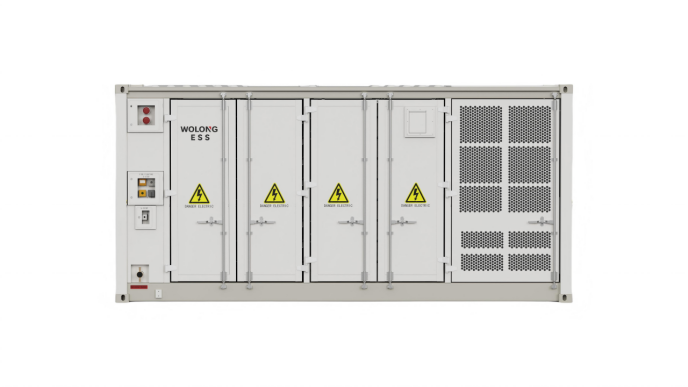
At Wolong, we often see customers compare battery capacities without considering the broader business context. A system that performs exceptionally well for a factory may be completely unsuitable for a solar farm or a utility substation. Understanding the real differences between C&I ESS and utility-scale energy storage is the key to making the right investment.
What Defines a C&I ESS?
A C&I ESS is installed behind the meter at commercial or industrial facilities such as manufacturing plants, warehouses, office buildings, shopping malls, hospitals, and data centers. Its primary purpose is to optimize the facility’s electricity consumption and improve power reliability.
Typical functions include peak shaving, demand charge reduction, time-of-use energy shifting, solar self-consumption, and backup power support. Because space is often limited at commercial sites, these systems are usually designed as compact, integrated cabinets that can be deployed quickly with minimal disruption to operations.
What Defines Utility-Scale Energy Storage?
Utility-scale energy storage is deployed on the grid side rather than at an individual customer site. These systems are commonly installed at solar farms, wind farms, substations, or dedicated battery storage facilities and are engineered to handle much larger amounts of energy.
Their main role is to support the electricity network by balancing supply and demand, integrating renewable generation, providing frequency regulation, and delivering other ancillary grid services. Containerized architectures, advanced thermal management, and sophisticated control systems are standard features of these large-scale installations.
The Most Important Difference: Project Objective
The clearest distinction between the two solutions is the problem they are designed to solve.
A C&I ESS is primarily an operational cost-saving tool. A factory, for example, can charge the battery when electricity prices are low and discharge it during expensive peak periods. The financial benefit is measured mainly through lower utility bills and improved operational continuity.
In contrast, utility-scale energy storage is a grid-support asset. A utility operator may use the battery to absorb excess solar generation at midday and release it during the evening peak. The value comes from maintaining grid stability, supporting renewable integration, and participating in electricity market services rather than reducing a single customer’s electricity bill.
Capacity and Installation Scale
Capacity requirements also differ dramatically.
Commercial and industrial projects typically range from several hundred kilowatt-hours to a few megawatt-hours. These installations are often completed within existing facility boundaries and can be expanded incrementally as energy demand grows.
Utility-scale projects usually start at tens of megawatt-hours and may reach hundreds of megawatt-hours. They require dedicated land, medium- or high-voltage interconnection infrastructure, and extensive engineering studies before construction begins.
Investment Approach and Payback
For commercial users, investment decisions are generally driven by a relatively straightforward business case. The payback period is calculated from demand charge savings, energy arbitrage opportunities, increased solar self-consumption, and the value of improved resilience.
For utility projects, the financial model is more complex. Revenue may come from capacity payments, frequency regulation markets, renewable firming contracts, and other grid-service mechanisms. Regulatory frameworks and market rules therefore play a much larger role in determining project economics.
Scalability and Future Expansion
Both solutions can be expanded, but the expansion strategy is different.
A C&I ESS is usually modular. Additional battery cabinets can be added as production capacity increases, new equipment is installed, or more rooftop solar is deployed. This allows businesses to scale their investment gradually.
Utility-scale energy storage is planned as part of a long-term grid or renewable development strategy. Expansion decisions must consider transmission capacity, interconnection agreements, and regional electricity demand forecasts, making the process far more complex.
Which Solution Fits Your Project?
If your organization operates a factory, warehouse, commercial building, hospital, or data center, a C&I ESS is generally the better fit. It offers lower electricity costs, improved energy independence, faster deployment, and flexible expansion.
If you are developing a solar farm, wind farm, utility substation, or grid-support project, utility-scale energy storage is the appropriate choice. It provides the large capacity, grid-level controls, and operational capabilities required for renewable integration and network stabilization.
At Wolong, we evaluate each project based on load profile, interconnection requirements, operational goals, and future growth plans before recommending a storage solution. This approach ensures that customers invest in a system that matches their actual business needs rather than simply selecting the largest available option.
Conclusion
The choice between C&I ESS and utility-scale energy storage is not about which technology is superior. It is about which solution aligns with your project’s objectives.
By matching the storage platform to the application, project owners can achieve better performance, stronger financial returns, and greater long-term value.
At Wolong, we believe the most successful battery storage projects begin with a clear understanding of the operational problem to be solved. Once that objective is defined, the right energy storage architecture becomes much easier to identify and optimize for long-term success.